ICARELIFE — Complete Reference Guide
Medical Gas Copper Tube:
Standards, Sizes, Cleaning,
Installation & Procurement
The complete reference for contractors, MEP engineers, and procurement teams — covering everything from material standards to commissioning requirements on hospital infrastructure projects.
Quick Answer
- Medical gas copper tube is a regulated safety component — not a commodity. It must be oxygen-cleaned, capped, certified, and traceable from the manufacturing mill
- The two main product standards are EN 13348 (Europe and international projects) and ASTM B819 (US-standard specifications)
- HTM 02-01 governs the entire UK medical gas pipeline system — it references EN 13348 for tube and adds installation, testing, and commissioning requirements
- Common sizes range from 6mm to 54mm OD for most hospital distribution — selection depends on gas type, flow demand, and system design
- Wall thickness determines pressure rating and must be selected based on system operating pressure and local code requirements
- Oxygen-service cleaning, sealed ends, traceability markings, and certified documentation are non-negotiable for all compliant tube
What is medical gas copper tube?

Medical gas copper tube is typically supplied clean, capped, and protected for medical gas service.
Medical gas copper tube is a seamless copper tube manufactured, degreased, and certified specifically for use in hospital medical gas pipeline systems (MGPS). It is a safety-critical component in any hospital infrastructure project.
Gases carried
Oxygen (O₂), nitrous oxide (N₂O), medical air, surgical air, vacuum (AGSS), carbon dioxide (CO₂), and nitrogen
Key applications
Operating theaters, ICU, NICU, general wards, endoscopy suites, emergency departments, and dental facilities
Compliance scope
Tube material (EN 13348 / ASTM B819), system design (ISO 7396), system installation (HTM 02-01 for UK)
What it is not
Not standard plumbing copper tube. Not ACR (refrigeration) tube. Not interchangeable with uncertified alternatives
Medical gas copper tube is classified as a medical device component in most regulatory frameworks. Its use is governed by national and international standards that define not just the material, but the manufacturing process, cleaning procedure, packaging, documentation, and traceability — all the way from the mill to the installed system.
In hospital projects, the medical gas pipeline system is typically specified by a mechanical or medical gas consultant. Their specification defines which standard applies, what documentation is required, and what level of third-party verification is expected. Understanding this before procurement is essential for contractors — late-stage non-compliance is one of the most costly errors in hospital MEP work.
Why it is different from standard or ACR copper tube
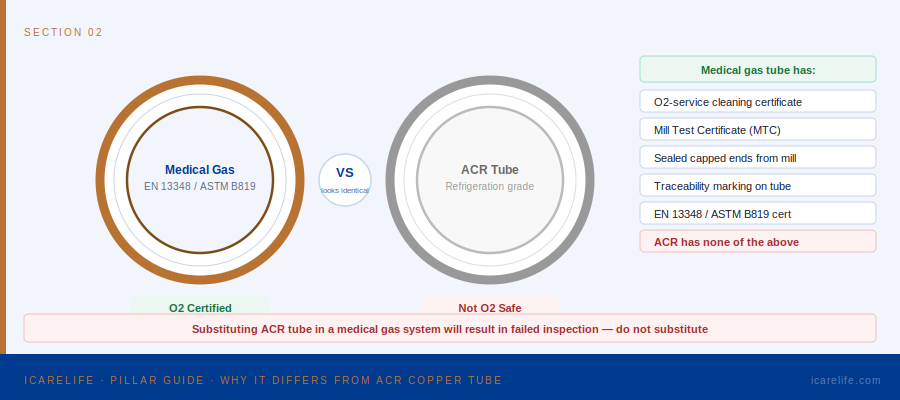
Medical gas copper tube is handled under stricter cleanliness, traceability, and packaging control than ordinary ACR tube.
This is the most common and most costly misunderstanding in medical gas procurement. Medical gas copper tube and ACR (air conditioning and refrigeration) copper tube can appear physically identical from the same manufacturer — same copper alloy, same dimensions — but they are fundamentally different products.
| Property | Medical gas copper tube | ACR copper tube | Standard plumbing tube |
|---|---|---|---|
| Oxygen-service cleaning | Required — certified | Not required | Not required |
| Residual hydrocarbon limit | Defined (EN 13348 / ASTM B819) | Not specified | Not specified |
| End caps / sealed packaging | Mandatory from mill | Optional | Not required |
| Traceability marking | Mandatory on tube surface | Not always required | Not required |
| Mill Test Certificate | Required | Optional | Not required |
| Suitable for O₂ service | Yes | No | No |
Standards overview
Medical gas projects commonly reference EN 13348, ASTM B819, ISO 7396, and sometimes HTM 02-01 depending on the governing specification. Four major standards govern medical gas copper tube at the product and system level. Understanding the scope of each is essential for correct procurement and project compliance.
| Standard | Publisher | Scope | Region | Tube compliant? |
|---|---|---|---|---|
| EN 13348 | CEN | Tube: material, cleanliness, dimensions | Europe, international | Yes — primary |
| ASTM B819 | ASTM International | Tube: material composition, manufacturing | USA, Philippines, some ASEAN | Yes — primary |
| HTM 02-01 | NHS England | Full system: design, install, commission | United Kingdom | References EN 13348 |
| ISO 7396-1 | ISO | System design and pipeline installation | Global (supplement) | References EN / ASTM |
EN 13348 vs ASTM B819 vs HTM 02-01: Full Standards Comparison
A detailed breakdown of each standard — scope, requirements, regional application, and common compliance mistakes for contractors.
Sizes and wall thickness overview

Medical gas copper tube is specified by outside diameter (OD) and wall thickness. The correct selection depends on the gas type, flow rate, system operating pressure, and design standard in use.
EN metric sizing (EN 13348 / EN 1057)
| OD (mm) | Common wall thickness | Typical application |
|---|---|---|
| 6mm | 1.0mm | Individual outlet drops (O₂, vacuum) |
| 8mm | 1.0mm | Local distribution at ward level |
| 10mm | 1.0mm | Zone distribution, small branch runs |
| 15mm | 1.0mm | Ward branch distribution, standard drops |
| 22mm | 1.0–1.5mm | Sub-main distribution, OR zone supply |
| 28mm | 1.5mm | Floor-level mains, OR suite supply |
| 35mm | 1.5mm | Department-level main distribution |
| 42mm | 1.5mm | Building risers, central plant connections |
| 54mm | 2.0mm | Primary mains from manifold/plant room |
ASTM imperial sizing (ASTM B819 Type K / L)
| Nominal size | Type K wall | Type L wall | Typical application |
|---|---|---|---|
| 1/2 inch | 0.049 in | 0.040 in | Outlet drops, small branch |
| 3/4 inch | 0.065 in | 0.045 in | Ward distribution |
| 1 inch | 0.065 in | 0.050 in | Sub-mains, OR supply |
| 1-1/4 inch | 0.065 in | 0.055 in | Floor-level mains |
| 1-1/2 inch | 0.072 in | 0.060 in | Department mains |
| 2 inch | 0.083 in | 0.060 in | Primary risers |
Cleaning and oxygen safety overview

Cleanliness control is critical because oil, grease, and particles can create ignition risk in oxygen systems.
All medical gas copper tube must be cleaned for oxygen service before installation. This is one of the most critical — and most frequently misunderstood — requirements in medical gas work.
Oxygen reacts violently with hydrocarbons at operating pressure. Even trace amounts of cutting oil, grease, or organic residue inside unclean copper tube can cause ignition when exposed to high-pressure oxygen flow. This is the primary reason medical gas tube is manufactured under a nitrogen-purged environment and supplied with sealed, capped ends.
What oxygen-service cleaning means
- Tube interior is degreased to remove cutting oils and organic residues from the drawing process
- Residual hydrocarbon content is tested and certified to limits defined in EN 13348 or ASTM B819
- Tube is purged with dry nitrogen and sealed at both ends with fitted plastic caps
- Caps must remain in place until the tube is ready to be brazed or connected on site
On-site requirements
- Any cutting of tube on site must be followed by internal cleaning and nitrogen purging before connection
- All brazing and jointing must be carried out under continuous nitrogen purge to prevent internal oxidation
- If tube cleanliness is compromised (exposed to air, debris, or grease), that section must be replaced — not cleaned on site
Installation overview
Medical gas copper tube installation is a specialist activity. It cannot be performed by general plumbing or HVAC trades without specific training and, in many countries, certification.
Key installation requirements
- Brazing only — all joints must be brazed, not soldered. Solder joints are not permitted in medical gas systems due to lower temperature and pressure ratings
- Nitrogen purge throughout — continuous nitrogen purge during all brazing operations to prevent internal oxidation scale formation
- Qualified personnel — in UK projects (HTM 02-01), installation must be carried out by personnel qualified as Competent Persons (CP) in medical gas pipework
- Support and fixing — spacing and method of tube supports must comply with the project specification and relevant code (BS EN or ASME as applicable)
- Zone valve positioning — zone valves must be installed in accessible, correctly labelled service positions per the system design drawings
- No open ends left exposed — all tube ends must remain capped during construction phase until final connection
Testing and commissioning overview

Medical gas pipeline systems must be tested and commissioned before clinical use. Testing is not a formality — it is a mandatory safety verification sequence. Failure at any stage requires rework and re-testing before the system can proceed.
Standard testing sequence
- Pressure strength test — system is pressurised to a test pressure above working pressure and held for a defined period to verify structural integrity of all joints and fittings
- Leak test — system held at working pressure and each joint inspected for leaks (leak detection fluid or electronic detection)
- Cross-connection test — verifies that each outlet delivers only the gas it is labelled for. This is among the most critical safety checks — cross-connected gas outlets have caused patient deaths
- Flow and pressure verification — confirms that working pressure and flow rate at each outlet meet design specification
- Gas purity test — for oxygen and nitrous oxide systems, gas purity at outlet is tested and verified against pharmacopoeial standards
- Validation and documentation — all test results documented, signed off by Authorised Person (or equivalent), and submitted as part of the commissioning record
Common testing failures
- Leaking brazed joints — most frequently caused by insufficient nitrogen purge during brazing or incorrect filler material
- Cross-connection errors — caused by incorrect labelling during installation phase, especially in complex multi-gas OR suites
- Pressure drop exceeding design — caused by undersized pipework or excessive restrictions in fittings layout
- Purity test failure — caused by contaminated tube, brazing oxidation, or inadequate system purge before testing
Certification and documentation
For any hospital project, medical gas copper tube must be accompanied by a complete, verifiable documentation package. This is requested at tender, verified at goods-in, and submitted as part of the project O&M manual.
-
Mill Test Certificate (MTC)
Confirms chemical composition and mechanical properties. Must reference the specific heat/batch number marked on the tube. Issued by the manufacturing mill — not a distributor.
-
Certificate of Conformity (COC)
Declares conformity to EN 13348 or ASTM B819. Must reference the exact standard revision number and apply to the specific batch supplied.
-
Oxygen-service cleaning certification
Confirms tube was cleaned and degreased to oxygen-service requirements. Residual hydrocarbon test results should be included or available on request.
-
Physical traceability marking on tube
Standard reference, OD and wall thickness, manufacturer, and batch/heat number must be physically marked on the tube surface. Verify at goods-in — not at commissioning.
-
Third-party test report (where specified)
Some international hospital tenders — particularly those with European or World Bank funding — require test reports from an accredited independent laboratory in addition to the above. Confirm this requirement at tender stage.
How to choose the right tube for your project
The right tube specification is determined by four factors: the governing standard, the gas type, the operating pressure, and the system design. Use this as a starting framework — always confirm with the project specification and consultant.
Use EN 13348 if your project has:
- A European, German, Dutch, or British consultant
- WHO, ISO, or HTM references in the specification
- Metric pipe sizing on system drawings
- Location in Europe, Middle East, or international hospital with EU financing
Use ASTM B819 if your project has:
- A US-trained engineer or American consultant
- NFPA 99 or ASHRAE references in the specification
- Imperial pipe sizing on system drawings
- Location in the Philippines, USA, or ASEAN with US-standard specification
Common mistakes to avoid
Based on experience across hospital infrastructure projects in Southeast Asia, the Middle East, and Europe, these are the most frequent and most costly errors in medical gas copper tube procurement and installation.
Top procurement and installation errors
- Substituting ACR tube for medical gas tube — the most common single cause of system rejection. Visually identical; certification and compliance are completely different.
- Accepting tube without checking end caps on delivery — damaged or missing caps mean the tube cleanliness cannot be guaranteed. The entire batch must be re-evaluated.
- Mixing EN and ASTM components without consultant approval — even when each component is individually certified, mixing standards in one system creates a compliance gap that will be flagged during inspection.
- Procuring from a distributor without mill-traceable documentation — COCs issued by a distributor (not the mill) are not accepted on most international hospital projects.
- Brazing without continuous nitrogen purge — produces internal oxidation scale that can contaminate the gas supply and cause system purity test failure.
- No cross-connection verification during zone-by-zone installation — cross-connection errors are extremely difficult to identify after full system completion. Verify each zone as it is installed.
- Submitting documentation only at commissioning — project specifications increasingly require documentation at goods-in and at interim inspection stages. Late submission causes programme delay.
Deep-dive article library
This pillar page provides a high-level overview of the complete topic. Each article below covers one subtopic in full depth — with contractor-specific guidance, tables, examples, and specification detail.
Medical Gas Copper Tube — Full Article Series
- 01 Medical Gas Copper Tube: Fundamentals, Properties, and Hospital Applications Fundamentals
- 02 Medical Gas Copper Tube Size System: EN Metric vs ASTM Imperial Guide Sizing
- 03 Wall Thickness and Pressure Ratings for Medical Gas Copper Tube Wall Thickness
- 04 Oxygen Cleaning, Degreasing, and Oxygen Safety for Medical Copper Tube Cleaning
- 05 Medical Gas Copper Tube Installation: Brazing, Purging, and Best Practices Installation
- 06 Testing and Commissioning Medical Gas Pipeline Systems Testing
- 07 EN 13348 vs ASTM B819 vs HTM 02-01: Standards and Certification Explained Standards
Frequently asked questions
Medical gas copper tube is a seamless copper tube manufactured, degreased, and certified specifically for use in hospital medical gas pipeline systems — supplying oxygen, nitrous oxide, medical air, vacuum, and other gases to clinical areas. It differs from standard or ACR copper tube in its oxygen-service cleanliness level, sealed end caps, certification documentation, and compliance with EN 13348 or ASTM B819.
EN 13348 (European) and ASTM B819 (US) are both valid standards for medical gas copper tube, but they differ in scope, dimensional system, and regional application. EN 13348 uses metric sizing and is the standard of choice for European, international, and WHO-referenced projects. ASTM B819 uses imperial sizing and applies to US-specification and Philippines-market projects. The governing standard for any project is determined by the project consultant's specification — not the project location.
No. ACR copper tube does not meet the oxygen-service cleanliness requirements of EN 13348 or ASTM B819 and is not certified for medical gas use. Using ACR tube in a medical gas system will result in failed inspection and typically requires full system replacement — one of the most costly compliance errors in hospital MEP projects.
Standard required documents are: (1) Mill Test Certificate (MTC) issued by the manufacturing mill, (2) Certificate of Conformity (COC) referencing EN 13348 or ASTM B819, (3) oxygen-service cleaning certification, and (4) physical traceability markings on the tube surface linking to the batch. Some international projects additionally require test reports from an accredited independent laboratory. All documentation should be verified at goods-in — not at commissioning.
For EN metric sizing: 15mm and 22mm OD are most common for ward distribution and branch runs; 28mm and 35mm for sub-mains and OR zone supply; 42mm and 54mm for building-level mains and plant room connections. For ASTM imperial: 1/2 inch and 3/4 inch for drops and branches; 1 inch and 1-1/4 inch for sub-mains. Size selection must be confirmed by the system designer based on flow calculations.
When copper tube is heated during brazing without an inert gas atmosphere inside, the copper oxidises — forming a black, flaky oxide scale on the internal tube surface. This scale can detach and travel downstream into valves, outlets, and patient equipment. In oxygen systems, loose scale particles also present an ignition hazard. Continuous nitrogen purge through the tube during all brazing operations prevents oxidation and is mandatory under all medical gas installation standards.
ICARELIFE — Hospital Infrastructure
Supporting your hospital project from specification to handover
ICARELIFE works with MEP contractors, project managers, and hospital developers across Southeast Asia, Europe, and the Middle East — providing specification-aligned medical infrastructure components including modular operating theaters, medical cleanrooms, and medical gas system support.