ICARELIFE — Engineering Guide
Negative Pressure Operating Room Design: Engineering Guide for Contractors
The complete technical reference for healthcare contractors, MEP engineers, and modular OT integrators — covering airflow logic, exhaust engineering, pressure monitoring, and commissioning.
Quick Answer
- Negative pressure ORs protect the hospital environment — not the patient — by keeping contaminated air inside the room.
- Negative pressure is created by running exhaust 10–15% higher than supply, maintaining –5 Pa to –15 Pa relative to adjacent spaces.
- Continuous DP monitoring, dedicated exhaust path, and airtight envelope are all mandatory — not optional.
- Both return-air strategies (100% OA and controlled recirculation) are valid — choice depends on infection risk profile and climate.
- Modular OT integration requires cross-discipline coordination from early design stage to achieve real containment performance.
1. Why Negative Pressure Operating Rooms Matter
Infection control in healthcare infrastructure extends beyond keeping the surgical field clean. Certain procedures — infectious surgery, aerosol-generating interventions, outbreak response — introduce airborne contamination risks that require a containment-first ventilation strategy.
In these cases, the ventilation objective reverses: instead of pushing clean air outward to protect the patient, the room must draw air continuously inward to prevent contaminated aerosols from reaching adjacent corridors, staff areas, or other patients.
Negative pressure OTs are typically required when hospitals need infectious-surgery capability, pandemic preparedness infrastructure, or high-risk aerosol procedure rooms. The result is a containment-driven room where exhaust design, pressure monitoring, envelope sealing, and commissioning discipline are primary engineering deliverables.
2. What Is a Negative Pressure Operating Room?
A negative pressure operating room is a surgical environment where air pressure inside is maintained lower than adjacent spaces — ensuring airflow direction is always inward when openings or leakage occur.
Typical pressure range
–5 Pa to –15 Pa relative to corridor or anteroom. Exact setpoint depends on standard and facility risk policy.
How it is created
Exhaust airflow must exceed supply airflow. Example: supply 3,000 m³/h, exhaust 3,300–3,450 m³/h.
When it is required
Infectious surgery, aerosol-generating procedures, isolation rooms, pandemic preparedness suites.
Not the same as isolation
Negative pressure is a ventilation regime, not an architectural feature. It requires active control and monitoring to be effective.

Negative pressure is achieved when exhaust airflow exceeds supply by 10–15%, creating consistent inward air movement from adjacent spaces into the operating room.
Some projects implement a pressure cascade (corridor → anteroom → OT) to create layered containment. This approach stages pressure across adjacent zones: corridor at 0 Pa, anteroom at –5 Pa, operating room at –10 Pa, reducing cross-zone contamination risk and making containment more predictable during door operations.
3. Core Design Principle: Airflow Must Always Move Inward
The core containment requirement can be stated in one sentence: contaminated air must never escape the room. Negative pressure is a system-level containment strategy — not a single HVAC parameter.
Airflow imbalance strategy
Negative pressure is maintained by designing exhaust airflow approximately 10–15% higher than supply. This provides stable inward airflow direction even during small disturbances from door events or occupant movement.
Door leakage compensation
No room is perfectly airtight. Real performance depends on how the system compensates for expected leakage through doors, penetrations, and access panels. A robust design includes predictable leakage paths (not random cracks), pressure sensors with feedback control, and fast recovery after door opening events.
4. Airflow Organisation Inside the Negative Pressure OR
Creating negative pressure is necessary but not sufficient. The internal airflow pattern must also protect the surgical field while capturing contaminated aerosols efficiently. Negative pressure OT airflow must balance four goals: sterile-zone protection, contaminant capture, turbulence control, and thermal/humidity stability.
Ceiling supply and downward flow
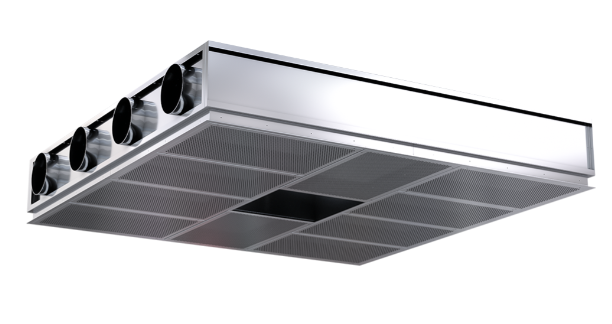
Most negative pressure ORs retain a controlled ceiling supply strategy — often laminar airflow — with high-efficiency filtration. Downward airflow supports the sterile field by pushing particles away from the critical zone, even in containment-priority rooms.
ACH vs containment — understanding the difference
- ACH (air changes per hour) — controls dilution: how quickly contaminants reduce via clean air exchange
- Exhaust dominance — controls containment: inward airflow direction and pressure regime
Both are required. ACH alone is not a containment strategy.
Avoiding short-circuit airflow
A common design error is positioning exhaust where it pulls supply air directly into the return path without traversing the occupied zone. Proper diffuser sizing, exhaust positioning, and smoke visualization testing during commissioning reduce this risk significantly.
5. Exhaust System Engineering Requirements
In a negative pressure OR, the exhaust system is the containment mechanism — not a secondary ventilation feature. When exhaust performance is unstable, negative pressure containment collapses immediately.
Dedicated exhaust path
A negative pressure OT must have a dedicated exhaust path (duct + fan + discharge), avoiding shared return systems that could reintroduce contamination.
HEPA filtration before discharge
In infectious or high-risk applications, exhaust air is HEPA filtered before outdoor discharge to protect maintenance personnel and reduce environmental risk. Some high-containment designs use redundant filtration stages.
Backflow prevention and discharge location
Backdraft dampers or check valves at the discharge point prevent reverse airflow during fan shutdown or wind-induced pressure reversal. Exhaust discharge must avoid re-entrainment into building fresh air intakes — rooftop discharge, adequate clearance distances, and careful intake separation are standard requirements.
Reliability and failure strategy
Because containment depends on exhaust continuity, design should include: pressure alarms, fan fault alarms, optional fan redundancy for critical rooms, filter differential pressure monitoring, and BMS integration for compliance documentation.
6. The No-Return vs Return Air Debate
One of the most debated decisions in negative pressure OT design is whether to eliminate return air entirely or allow controlled recirculation. Both approaches can be valid — the correct choice depends on infection risk profile, climate/energy constraints, and the facility's operational policy.
Philosophy A: No return air (100% OA + 100% exhaust)
Air moves in a one-way path: Outdoor → AHU → Room → Exhaust → Outdoor. This offers the clearest containment logic because contaminated air is never recirculated.
Trade-offs: Higher energy demand, increased dehumidification load (critical in tropical climates), and larger AHU capacity requirements to maintain stable temperature and RH.
Philosophy B: Return + exhaust (controlled recirculation)
Return air is used alongside a dedicated exhaust system that still creates negative pressure. Exhaust > Supply remains the governing rule. Return must be served by a dedicated AHU and appropriately filtered.
Benefits: Improved humidity and temperature stability, smaller required AHU capacity, reduced operational cost.
The core engineering truth
- Negative pressure is defined by exhaust dominance — not by the presence or absence of return grilles.
- Eliminating return does not guarantee containment if exhaust design or controls are weak.
- Allowing return does not reduce safety if return is isolated, filtered, and exhaust remains dominant.
| Decision Factor | No Return (100% OA) | Return + Exhaust (Dedicated AHU) |
|---|---|---|
| Infection risk profile | High-containment infectious surgery | Occasional infectious capability |
| Energy & humidity | Higher load, complex RH stability | Better RH stability, lower OPEX |
| Defensibility | Strongest one-way air path narrative | Requires clear isolation explanation |
| Typical project use | Policy prioritises containment above all | Dedicated AHU available; stability critical |
7. Pressure Monitoring & Control Systems
Negative pressure is not achieved by design intent alone. It must be continuously measured, controlled, and verified. A pressure-controlled operating room is an active system — not a passive airflow imbalance.
Differential pressure monitoring
Requirements: low-range DP sensor (room vs corridor/anteroom), continuous local display with alarm at entrance, and trend logging for compliance and troubleshooting.
Active control logic
Typical control loop: Pressure sensor → controller → exhaust fan VFD or modulating dampers → pressure correction. Exhaust-driven control is often more stable because exhaust directly governs room pressure.
Door opening events and pressure recovery
Door events can temporarily collapse differential pressure. Commissioning must include door-event testing to verify recovery performance under real workflow conditions — not only static balancing.
ASHRAE 170 — Ventilation of Health Care Facilities: pressure relationships, ACH requirements, monitoring protocols
HTM 03-01 — UK/Commonwealth: ventilation for healthcare premises including OR pressure requirements
GB 50333 — China: Architectural Technical Code for Hospital Clean Operating Department
ISO 14644-4 — Cleanroom design and construction: applicable to controlled surgical environments
EN 13501 — Fire classification: relevant for fire-rated components in the sealed OR envelope
8. Positive vs Negative Pressure Operating Rooms: Engineering Comparison
Positive and negative pressure strategies are designed to solve different risk scenarios. Understanding the differences prevents misapplication and supports correct tender specifications.
| Parameter | Positive Pressure OR | Negative Pressure OR |
|---|---|---|
| Primary objective | Protect sterile field and patient | Contain airborne contamination |
| Pressure relationship | Room higher than adjacent spaces | Room lower than adjacent spaces |
| Airflow direction | Outward (OR → corridor) | Inward (corridor → OR) |
| Airflow balance logic | Supply > Exhaust | Exhaust > Supply |
| Exhaust system role | Support ventilation balance | Primary containment mechanism |
| Return air | Common (recirculation) | Optional; must be isolated if used |
| Monitoring requirement | Recommended | Critical (continuous DP + alarm) |
| Energy demand | Moderate | Often higher (100% OA designs) |
9. Engineering Challenges in Modular Negative Pressure OT Implementation
Negative pressure rooms can appear correct on paper but fail in real projects due to envelope leakage, poor balancing, or insufficient commissioning. In modular operating theatres, implementation requires cross-discipline coordination from early design stage.
Envelope airtightness
Pressure stability depends on envelope integrity. Typical leakage points include modular panel joints, ceiling interfaces, access panels, and MEP penetrations. A modular envelope must be treated as a pressure boundary — not only an architectural finish layer.
Door leakage and pressure recovery
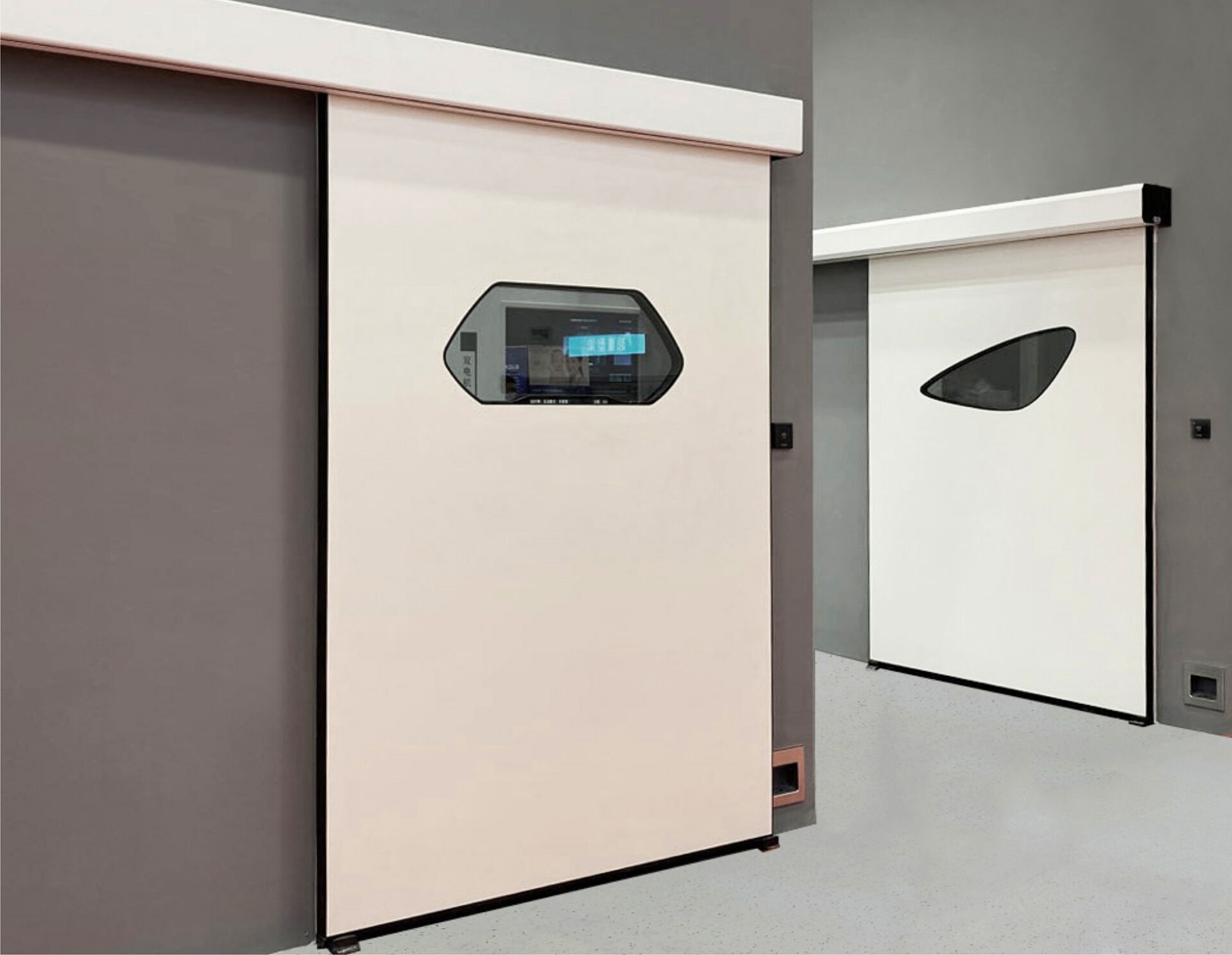
Poor sealing or misaligned frames cause frequent pressure alarms and force higher exhaust compensation. Door quality, sealing design, and installation accuracy directly affect containment stability — every gap is a performance variable.
Duct routing constraints
Modular OTs carry dense ceiling coordination — laminar ceiling modules, medical gas pipework, electrical trays, and surgical light pendants. Adding dedicated exhaust ducting creates spatial conflicts if not resolved early in the design coordination process.
Humidity control in tropical climates
In high-humidity regions, 100% outdoor air strategies significantly increase dehumidification demand. AHU coil sizing, control tuning, and condensation risk management become critical to maintaining stable RH — particularly during extended surgical sessions.
Common failure patterns
- Room passes static balancing check but fails during real workflow — door opening, staff movement, filter loading
- Commissioning limited to static measurement; door-event recovery never tested
- Envelope penetrations left unsealed during fit-out by trades not briefed on pressure boundary requirements
- Exhaust fan fault with no alarm or BMS integration — pressure loss goes undetected during surgery
10. Integrating Negative Pressure into Modular OT Systems
Negative pressure performance is achieved when architectural envelope, airflow organisation, exhaust strategy, and control logic are designed as one integrated system. Modular operating theatres support this well when integration is addressed from the early coordination phase.
Envelope integrity as a pressure-control component
Key requirements: sealed panel joints with defined sealing methods, gasketed access panels, controlled penetrations for medical gas and electrical services, and door-frame sealing integrated into the wall system specification.
Door systems for containment environments
In negative pressure applications, doors function as containment interfaces — not only architectural elements. Hermetic door selection and installation accuracy must be part of the containment specification from the outset, not an afterthought.
Coordinating laminar ceiling with exhaust placement
Exhaust placement must support contaminant capture without disrupting clean-zone supply patterns. Early coordination between the laminar ceiling supplier, AHU designer, and modular OT contractor prevents spatial conflicts and ensures effective capture behaviour.

Negative pressure performance in modular OTs depends on envelope airtightness, exhaust design, and pressure monitoring working as one integrated system.
Dedicated AHU and smart monitoring integration
A dedicated AHU enables independent balancing and more stable humidity control. Pressure displays, alarms, and BMS connectivity support predictable commissioning outcomes and long-term compliance documentation for facility management and accreditation purposes.
Frequently Asked Questions
Most negative pressure operating rooms are maintained at –5 Pa to –15 Pa relative to adjacent corridors or anterooms, per ASHRAE 170 and equivalent regional standards, with continuous monitoring and alarm integration.
Negative pressure is created when exhaust airflow exceeds supply airflow by approximately 10–15%, ensuring inward airflow from adjacent spaces through doors, gaps, and controlled leakage paths.
Return air may be used when served by a dedicated AHU with proper isolation and filtration. High-containment designs may eliminate return air entirely and operate on a 100% fresh air and 100% exhaust basis for maximum containment defensibility.
In infectious or high-risk applications, exhaust air is typically HEPA filtered before outdoor discharge to reduce environmental risk and protect maintenance personnel. Some high-containment designs use redundant filtration stages.
If differential pressure drops below threshold, containment integrity is compromised. Pressure alarms, fan fault alarms, and rapid recovery control logic are critical safeguards. Without monitoring, failure may go undetected during live surgical procedures.
Conversion is possible but requires rebalancing supply and exhaust airflow, installing a dedicated exhaust path, adding continuous pressure monitoring, and verifying envelope airtightness. It is not a simple control adjustment.
Negative pressure operating rooms typically operate at 15–25 ACH depending on applicable standards and room classification. ACH supports dilution; negative pressure itself is achieved by exhaust dominance — both are required.
Not automatically. Containment depends on exhaust system design, filtration quality, control stability, and envelope integrity. Eliminating return air increases containment margin but also increases energy demand and humidity-control complexity.
A dedicated AHU isolates airflow control, improves humidity stability, reduces cross-room contamination risk, and simplifies balancing and commissioning verification — making it the preferred configuration for containment-priority rooms.
ICARELIFE — Hospital Infrastructure
Planning a Containment-Ready Operating Theatre?
Healthcare contractors and MEP partners working on negative pressure OR projects can request technical coordination support — covering modular envelope planning, exhaust strategy, pressure logic, and commissioning-ready design inputs.