ICARELIFE — Technology Comparison
Coulomb-Force Plasma vs Electrostatic (ESP) Air Purification
Both use an electrical field to clean air — but they behave very differently in an occupied room. Here is how Coulomb-force plasma purification compares with traditional high-voltage electrostatic (ESP), and why it matters for hospital and office spaces.
Quick Answer
- ESP relies on an open metal-plate corona — high ionisation energy, and ozone that can exceed 0.05 mg/m³.
- Coulomb-force plasma uses insulated electrodes and low-energy, controlled discharge, holding ozone within 0.03 mg/m³.
- ESP sterilises mainly through incidental ozone; Coulomb-force plasma actively inactivates microbes.
- ESP suits industrial exhaust and unoccupied disinfection; Coulomb-force plasma suits occupied wards and offices.
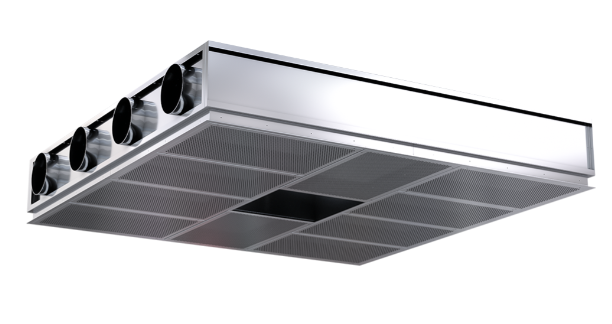
- ICARELIFE’s Ceiling Laminar AC and Disinfection System uses Coulomb-force plasma purification.
Two different discharge principles
Electrostatic and Coulomb-force plasma both charge particles with an electric field, but the way they generate that field is what separates them.
Traditional high-voltage electrostatic precipitation (ESP) uses open metal plates that create a strong corona discharge at high ionisation energy. That intense discharge is effective at charging dust, but it also splits oxygen molecules and generates ozone as a by-product — often at levels that exceed the 0.05 mg/m³ comfort threshold for occupied spaces.
Coulomb-force plasma purification takes a different route. The electrodes are wrapped in an insulating dielectric, so the discharge is low-energy and controllable rather than an open high-energy corona. This produces an active low-temperature plasma that inactivates microorganisms directly, while keeping ozone generation to a trace amount that is catalytically broken down to a stable level within 0.03 mg/m³.
Side-by-side comparison
The practical differences come down to five factors that any specifier evaluating air purification for a healthcare space should weigh.
| Factor | Traditional Electrostatic (ESP) | Coulomb-Force Plasma |
|---|---|---|
| Discharge type | Open metal-plate corona; high ionisation energy | Insulated-dielectric electrodes; low-energy controlled discharge |
| Ozone output | Higher — can exceed 0.05 mg/m³ | Trace — catalytically stabilised within 0.03 mg/m³ |
| Sterilisation | Incidental, via ozone; low plasma intensity | Active low-temperature plasma inactivation; higher efficiency |
| Dust-collection structure | Flat collection plate; small surface area | Honeycomb dielectric channel; large area, strong ultrafine capture |
| Best-suited application | Industrial exhaust; unoccupied-area disinfection | Hospital wards, offices and other continuously occupied spaces |
Which technology belongs where
Neither method is universally “better” — each is engineered for a different environment. The choice depends on whether people are present during operation.
Choose ESP when:
- The application is industrial exhaust or process air
- The space is unoccupied during disinfection
- High ozone output is acceptable or even intended
- Bulk dust capture is the primary goal
Choose Coulomb-force plasma when:
- The room is occupied 24 hours a day
- Active microbial inactivation is required
- Ozone must stay within occupied-space limits
- Ultrafine particle capture matters (wards, theatres, offices)
For healthcare infrastructure — patient rooms, consulting rooms, operating environments — the occupancy condition almost always points to controlled plasma over open electrostatic discharge.
What ICARELIFE uses — and why
Our air disinfection is built around the occupied-room use case, so the technology choice follows directly from it.
The ICARELIFE Ceiling Laminar AC and Disinfection System uses Coulomb-force plasma purification. It combines active low-temperature plasma disinfection with a honeycomb dielectric structure for strong ultrafine particle capture, while holding ozone within 0.03 mg/m³ — well inside the limits for continuously occupied clinical spaces.
In practice this means the system can run around the clock in a ward or theatre without emptying the room, delivering laminar clean-air distribution and active disinfection at the same time.
Ceiling Laminar AC & Disinfection System — Technical Q&A
Power, installation, air purification and maintenance — the questions professional buyers ask most.
Frequently Asked Questions
No. Both use an electric field, but ESP relies on an open metal-plate corona at high ionisation energy, which produces significant ozone. Coulomb-force plasma uses insulated electrodes and a low-energy, controlled discharge that actively inactivates microbes while keeping ozone to a trace level within 0.03 mg/m³. The two are suited to opposite environments.
ESP creates a strong open corona to charge particles, and that high-energy discharge splits oxygen molecules into ozone as a by-product, often above 0.05 mg/m³. Coulomb-force plasma uses a lower-energy discharge through an insulating dielectric, and any trace ozone is catalytically broken down, holding the stable level within 0.03 mg/m³.
For continuously occupied spaces such as wards and offices, Coulomb-force plasma is the appropriate choice because it disinfects actively while keeping ozone within occupied-space limits. ESP is better suited to industrial exhaust or unoccupied-area disinfection where higher ozone output is acceptable. ICARELIFE’s Ceiling Laminar AC and Disinfection System uses Coulomb-force plasma for this reason.
1. GB/T 18883-2022, Standards for Indoor Air Quality — ozone limit 0.16 mg/m³ (1-hour average). Standardization Administration of China.
2. World Health Organization, Global Air Quality Guidelines (2021) — ozone 0.10 mg/m³ (8-hour daily maximum). who.int
3. US FDA, 21 CFR 801.415 — Maximum Acceptable Level of Ozone — 0.05 ppm for devices in occupied spaces including hospitals. ecfr.gov
Product performance figures (ozone output, disinfection rates and specifications) are ICARELIFE test and datasheet data.
ICARELIFE Technical Team
Healthcare infrastructure specialists with extensive experience in modular operating theaters, medical cleanrooms, and MEP system integration. ICARELIFE — Innovating Spaces That Heal.
Related from ICARELIFE
Read more on air disinfection and how it fits a wider system.
ICARELIFE — Air Disinfection Technology
Specifying air disinfection for occupied spaces?
ICARELIFE supplies Coulomb-force plasma air disinfection engineered to run continuously in occupied clinical and commercial spaces. Share your room requirements and our technical team will help you specify a compliant, documented solution.