ICARELIFE — Technical Guide
Corian Solid Surface for Medical Spaces: Properties, Uses and Specification Checks
A material reference for contractors, MEP engineers and hospital consultants: sourced properties, fire data, what each certificate covers, applications and a specification checklist.
Quick Answer
- Corian solid surface for medical spaces is non-porous, with bonded seams and a surface that can be repaired.
- Fire data: flame spread and smoke developed indexes below 25 under ANSI/UL 723 for 6 and 12 mm sheet.
- GREENGUARD Gold means low emissions, not VOC-free; NSF/ANSI 51 is a food zone certificate.
- Specify grade, joint method, adhesive data and approved cleaners, and ask for current certificates.
Why Solid Surface Suits Medical Spaces
Surfaces in clinical rooms are cleaned often and judged by how few places dirt can lodge. Solid surface is chosen mainly for its joint detail and its repairable finish.
Corian solid surface for medical spaces is an acrylic-based sheet material that fabricators cut, join and shape into sinks, counters, cladding and furniture. The manufacturer describes it as non-porous and homogeneous, so the color and structure run through the full thickness of the sheet. Joints between sheets are bonded and sanded, which the manufacturer describes as inconspicuous seams without crevices that trap dirt.
Corian Properties for Healthcare
The table lists statements from the manufacturer's own documents. It shows the source beside each value so the specifier can request the current edition.
| Property | Manufacturer statement | Source |
|---|---|---|
| Surface structure | Non-porous and homogeneous; does not support growth of mold, mildew or bacteria when properly cleaned | Healthcare brochure, 2020 |
| Seams | Inconspicuous seam technique, designed with no crevices to trap dirt | Healthcare brochure, 2020 |
| Repair | Marks and scratches can be removed easily | Healthcare brochure, 2020 |
| Forming | Can be thermoformed into shaped parts; sink and countertop can be formed in one press | Healthcare brochure, 2020 |
| Water absorption | 0.05% by weight in 24 hours; 0.5% long term | Performance properties bulletin |
| Stain and chemical resistance | Pass, test ISO 19712-2 | Performance properties bulletin |
| Heat | NEMA LD 3-3.6 high temperature: no change; wet heat and dry heat: pass | Performance properties bulletin |
| Surface burning | Flame spread index below 25 and smoke developed index below 25, ANSI/UL 723 (ASTM E84); Class A under NFPA 101 | Fire performance bulletin (standard grade, 6 and 12 mm, all colors) |
| Sheet thickness | 6 mm and 12 mm listed | Performance properties bulletin |

Applications in Medical Spaces
The same material appears in four groups of medical fixtures. Each group has its own specification points.
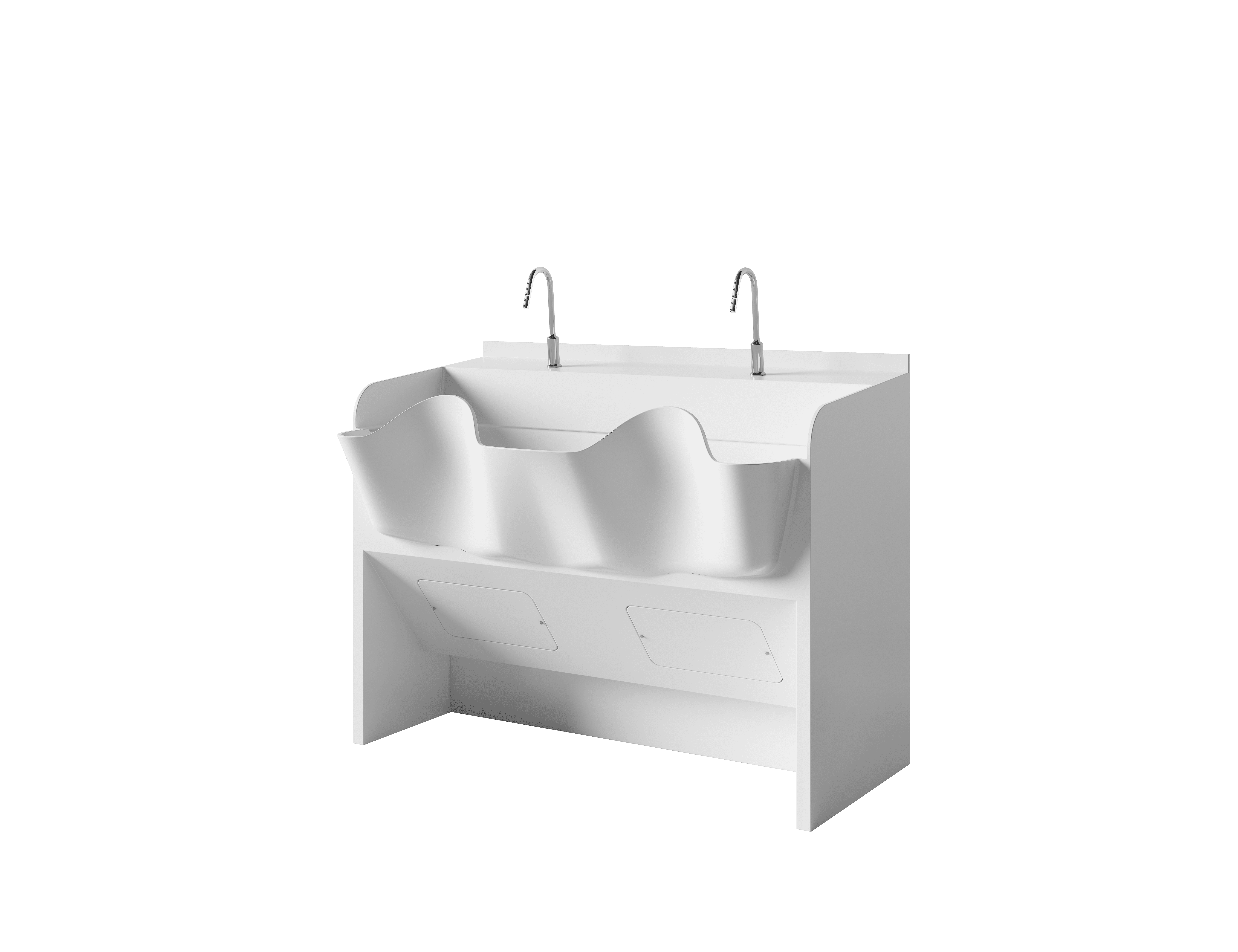
Surgical scrub sinks
A bowl formed or bonded from one material removes the joint between bowl and deck. Sensor taps, splash height and bowl depth are agreed with the surgical team. Installation steps are covered in the scrub sink installation guide, and the fixtures are listed on the Corian surgical sink page.


Cabinets, wall units and patient room furniture
Vanities, wall cabinets and storage units can use the same sheet. Edge and corner details decide how well a unit can be wiped down, and a recessed work niche or integrated sink keeps the number of joints low.


Nurse stations, reception and waiting areas
High-touch counters benefit from rounded edges, shaped returns and integrated sinks, which thermoforming and bonded joints allow. Long continuous counters need planned movement joints and clear seam positions.


Wall cladding
Solid surface sheet can clad walls where a joint-free look and a repairable finish matter. Steel-faced panel systems are another option for full operating room envelopes; see the operating room wall panel page and the modular operating theater guide for how the envelope fits with doors and airflow. The cladding sequence is shown in section 7.
Solid Surface vs Laminate vs Stainless Steel
No single material wins on every point. The comparison below uses general fabrication practice, not test results, so confirm each row against the products under review.
| Point to compare | Solid surface | Laminate (HPL) | Stainless steel |
|---|---|---|---|
| Joints | Sheets bonded and sanded; seam quality depends on the fabricator | Panels and edges joined with visible edges or edge bands | Welded and ground, or mechanically joined |
| Surface repair | Marks and scratches can be removed (manufacturer statement) | Surface layer is thin, so deep damage usually means replacement | Depends on the finish; a brushed finish is easier to blend than a mirror finish |
| Forming | Thermoforming and bonded shapes | Mainly flat parts with post-formed edges | Bent and welded forms |
| Cleaning chemicals | Check the manufacturer care guide for the disinfectants in use | Check the laminate maker's guide | Check chloride-containing products against the grade used |
The choice often follows the project: a stainless frame with a solid surface basin is one way to combine both, and ICARELIFE lists such a hybrid sink. The right material depends on cleaning chemistry, joint detail and fabricator capability.
Certifications and What They Cover
A certificate covers a defined scope. Reading the scope avoids claims the document does not support.
| Item | What the sources say | What it does not cover |
|---|---|---|
| GREENGUARD Gold (UL 2818) | Listed in the manufacturer's health product declaration; low chemical emissions, tested to the California Department of Public Health method v1.1-2010 | Not a statement that the material is free of VOCs. The declaration itself marks VOC content data as not applicable |
| NSF/ANSI 51 | Listed for food zone applications | Not a healthcare or infection control certificate |
| Independent hygiene testing | The brochure says LGA QualiTest GmbH certified hygienic performance, with tests for stability against bacteria and fungi | The sources reviewed give no test standard or result, so no antimicrobial claim follows |
| Fire performance | Surface burning results under ANSI/UL 723 (ASTM E84), Class A under NFPA 101, for standard grade 6 and 12 mm | Not an assembly rating; local code and the authority having jurisdiction decide approval |
Cleaning, Disinfectants and Limits
The manufacturer pages reviewed describe the material as easy to clean and sterilize but do not list approved disinfectants. That information sits in the care guide.
- Obtain the manufacturer's care and maintenance guide and compare it with the clinic's disinfectant list, including dilution and contact time.
- Record the approved cleaning products in the handover documents so later maintenance staff use the same ones.
- Check heat exposure near equipment and hot items against the heat test results in section two.
- Use the repair method the manufacturer describes for scratches, and schedule it as planned maintenance, not as emergency work.
Cleaning protocols differ between countries and between clinics, so the infection control team has the final say on the products used.
Specification and Fabrication Checklist
A short checklist in the specification helps keep the delivered work in line with the data sheet.
Wall cladding sequence
For wall cladding, the method statement should show the order of work. The photo sequence below shows one method for bonded sheet cladding on a metal frame: setting out, framing, brackets, joint bonding, clamping, trimming, surface filling, polishing and handover. The project's approved method statement and the manufacturer's fabrication guide govern.

Specification checklist
- Material and grade
Name the product, grade, thickness and color, and attach the current data sheet.
- Certificates
Request current GREENGUARD and any other certificate named in the tender, with the scope and expiry date.
- Joint method
State the adhesive, seam position rules and the finish expected at each joint.
- Joint emissions
Ask for emission data on the adhesive and sealants, not only the sheet.
- Fabricator
Ask for fabrication training evidence and photos of earlier medical work.
- Shop drawings
Approve cutouts, tap holes, splash heights, radii and support frames before cutting.
- Site checks
Check seams, edges and silicone lines at handover, and keep photos.
- Care package
Supply the care guide, repair method and approved cleaners with the handover pack.
Common Specification Mistakes
Many site problems trace back to the wording of the specification, not to the material.
Frequent specification gaps
- Writing antimicrobial, VOC-free or lab-verified without a certificate or test report for the exact product.
- Quoting a food zone certificate as proof of healthcare suitability.
- Leaving seam positions to the site team, which puts joints at the sink rim or splash edge.
- Approving the sheet but not the adhesive, sealant or support frame.
- Not recording the approved cleaning products at handover.
Frequently Asked Questions
The manufacturer describes Corian as non-porous, with inconspicuous seams, and states that it does not support the growth of mold, mildew or bacteria when properly cleaned. Suitability still depends on the application, the cleaning and disinfection routine, and local rules. Check disinfectant compatibility in the manufacturer's care guide before approval.
The manufacturer sources reviewed describe Corian as non-porous and not supporting microbial growth when properly cleaned. They give no antimicrobial test result such as ISO 22196. Do not specify the word antimicrobial without a test report for the exact product.
That wording is not supported. The manufacturer's health product declaration lists GREENGUARD Gold certification (UL 2818), which covers low chemical emissions, and says VOC content data is not applicable to this product category. Ask the fabricator for the current certificate and for emission data on the joint adhesive.
The declaration lists NSF/ANSI 51 for food zone applications, which concerns materials for food equipment. It is not a healthcare performance certificate, so it does not replace infection control or cleanability review.
The manufacturer's fire bulletin reports a flame spread index below 25 and a smoke developed index below 25 under ANSI/UL 723 (ASTM E84) for standard grade 6 mm and 12 mm sheet, and Class A under NFPA 101. That is a material result, so wall assemblies and local code approval are checked separately.
The manufacturer states that marks and scratches can be removed easily. Deep damage and seam repairs are usually left to a trained fabricator so the finish and joint stay uniform.
Standards and References
- DuPont. Corian Design: the ideal surfacing solution for today's healthcare environment (brochure), 2020. DuPont PDF
- Corian. Solid surface technical bulletin: performance properties. Corian PDF
- Corian. Solid surface technical bulletin: fire performance. Corian PDF
- Health Product Declaration: Corian Solid Surface, DuPont Specialty Products USA, LLC (published November 2019). HPD repository
- Corian. Healthcare applications. corian.com
- ANSI/UL 723 (ASTM E84), surface burning characteristics of building materials; ISO 19712-2, decorative solid surfacing materials; UL 2818, chemical emissions. Check the edition adopted locally.
ICARELIFE — Solid Surface Medical Fixtures
Specifying solid surface fixtures for a medical project?
Send drawings and room schedules to receive coordinated information on scrub sinks, counters and cladding, with the data sheets, certificates and installation details needed for tender review.