ICARELIFE — Material Guide
What Is Solid Surface Material? Composition & Medical-Grade Properties
The material science behind seamless medical sinks — what solid surface is made of, how it performs, and why hospitals specify it for hygiene-critical areas.
Quick Answer
- Solid surface material is a non-porous composite of acrylic resin, alumina trihydrate, and mineral fillers.
- Water absorption ≤0.1% means bacteria cannot penetrate the surface.
- Antibacterial performance is intrinsic to the material — not a coating that wears off.
- Thermoformed as a single seamless piece; refinishable on site.
What Is Solid Surface Material?
A short definition before the material science.
Solid surface is a man-made composite material, first commercialized by DuPont as Corian in 1967. It combines acrylic resin with mineral fillers to produce a dense, non-porous solid that can be thermoformed, joined invisibly, and polished. Unlike laminates or coated boards, the material is homogeneous — the same composition runs through its full thickness, which is why scratches can be sanded out and the surface renewed in place.
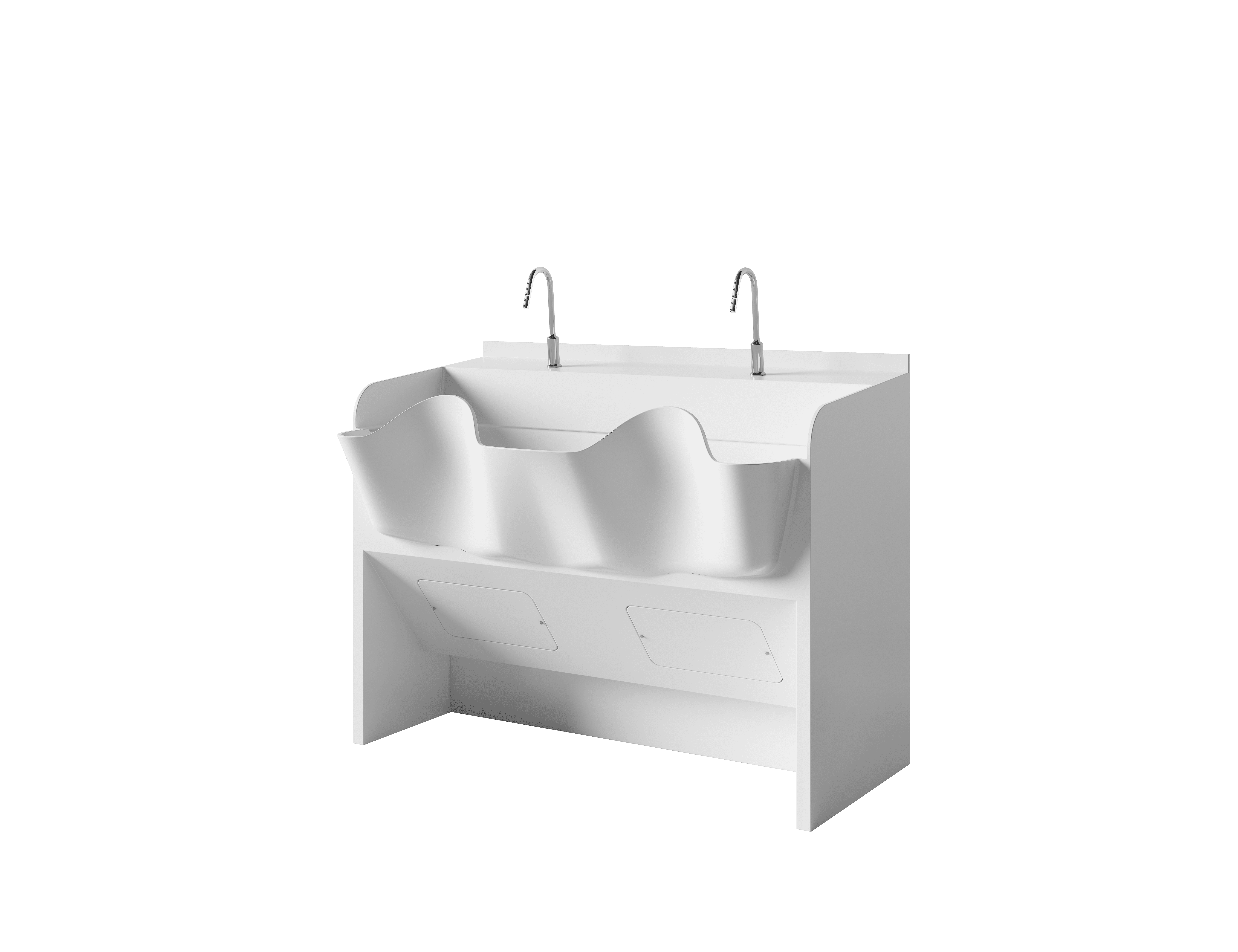
In healthcare, solid surface has moved from countertops into hygiene-critical fixtures: surgical scrub sinks, clinic sinks, nurse stations, and neonatal care units — anywhere seams, pores, and joints create infection control risk.
Composition: What Medical-Grade Solid Surface Is Made Of
Three components determine performance — and the resin choice matters most.
| Component | Proportion | Function |
|---|---|---|
| Pure acrylic resin (MMA) | 30–40% | Binder; provides toughness and anti-yellowing stability |
| Alumina trihydrate (ATH) | 50–60% | Flame retardancy and surface hardness |
| Mineral fillers | 5–15% | Impact strength |
| Color pigments | Trace | Uniform color through full material thickness |
Solid Surface Performance Data for Healthcare Use
The numbers infection control teams and specifiers ask about.
| Indicator | Typical Value | Why It Matters |
|---|---|---|
| Antibacterial rate | ≥99.9% (S. aureus, E. coli) | Third-party tested; intrinsic to the material, no coating to wear off |
| Water absorption | ≤0.1% | Non-porous — bacteria cannot penetrate the surface |
| Fire performance | B1 classification (difficult-to-burn) | ATH filler provides flame retardancy |
| Anti-yellowing | ΔE ≤ 2 per JC/T 908-2013 | No visible yellowing over 10 years of normal indoor use |
| Heat resistance | Short-term to 100 °C | Daily hot water use (≤80 °C) is safe |
| Surface hardness | 85–90 HRM | Comparable to marble; refinishable when scratched |
Seamless One-Piece Molding: The Structural Difference
The manufacturing method — not just the material — drives the hygiene advantage.
Stainless steel sinks are fabricated by welding multiple plates, which is simply how metal fixtures are formed. Solid surface basins are thermoformed and cured as a single piece: no seams, no corners, no joints. Where seam-level infection control leads the specification, single-piece construction is the more direct answer — there is nowhere for biofilm to establish that a routine wipe-down cannot reach.
The same property allows invisible joining during fabrication. Basin, deck, splash guard, and cabinet faces present one continuous cleanable surface, with rounded internal radii instead of right-angle corners.
No Seams
Single-piece thermoformed basin removes the weld lines where bacteria colonize in fabricated sinks.
Renewable Surface
Homogeneous composition means scratches sand out and gloss restores with on-site polishing — no replacement.
Warm to Touch
Unlike metal, the surface is warm and quiet in use — a small but noticed comfort factor for clinical staff.
Fully Customizable
Thermoforming supports custom colors and dimensions that fabricated stainless steel cannot match.
Where Solid Surface Is Used in Hospitals
The material's applications now span the full hygiene-critical fixture range.
Typical applications include surgical scrub sinks at OR entrances, clinic and ward sinks, nurse station counters, neonatal bathing units, and laboratory work surfaces. The common thread: environments with repeated disinfection, high hygiene expectations, and long planned service life.
Solid Surface vs Stainless Steel Scrub Sinks: 11-Point Comparison
Now that you know what the material is, see how it compares against stainless steel across every specification dimension.
Frequently Asked Questions
Corian is DuPont's brand name for the solid surface material category it invented in 1967. Many manufacturers now produce solid surface. For medical use, what matters is the formulation (pure acrylic vs polyester blends) and whether the product is engineered for clinical environments — splash geometry, antibacterial performance, and certification support.
No. In quality medical-grade formulations, silver-ion antibacterial agents are mixed into the material itself, not applied as a coating. The property persists for the material's lifetime — even after refinishing, because the composition is identical through the full thickness.
Under normal clinical use, no. Pure acrylic solid surface is tougher than ceramic and meets the JC/T 908-2013 anti-yellowing standard (ΔE ≤ 2, imperceptible to the eye, over 10 years). Yellowing is usually caused by prolonged direct sunlight or bleach-based cleaners; cracking requires heavy sharp impact or thermal shock such as boiling water on a cold surface.
ICARELIFE Technical Team
Healthcare infrastructure specialists with extensive experience in modular operating theaters, medical cleanrooms, and MEP system integration. ICARELIFE — Innovating Spaces That Heal.
Related Solutions from ICARELIFE
Continue the surgical scrub sink series or explore the systems this material supports.
ICARELIFE — Solid Surface Medical Fixtures
Need material documentation for your specification?
ICARELIFE provides third-party antibacterial test reports, material data sheets, and certification packages for solid surface scrub sinks and medical fixtures. Our technical team supports contractors and consultants preparing tender documentation for international hospital projects.