ICARELIFE — Complete Technical Guide
Surgical Scrub Sinks: The Complete Technical Guide for Hospital Projects
Everything contractors, consultants, and hospital procurement teams need to specify a surgical scrub sink — materials, configurations, installation, standards, and lifecycle planning.
Quick Answer
- A surgical scrub sink is the operating room's first infection control checkpoint before the sterile field.
- Two main material categories: seamless solid surface and welded stainless steel — each fits different project priorities.
- Specify by station count (1–3), mounting method, faucet type, and required certifications.
- Solid surface suits infection-control-led specs; stainless steel suits budget-led or high-temperature zones.
Why the Scrub Area Is the OR's First Infection Control Checkpoint
Before any material or model discussion, it helps to understand what the scrub area must achieve — and where traditional designs fall short.
The surgical scrub sink is where clinical staff transition from the general hospital environment to the sterile field. Surgical hand antisepsis performed here is one of the most heavily protocolized routines in the operating suite. If the scrub station splashes water onto gowns, harbors bacteria in seams, or forces staff into fatiguing postures, the failure propagates into every procedure that follows.
Four recurring problems drive modern scrub sink specification:
Seam Harborage
Welded joints and silicone-sealed corners can shelter biofilm where brushes and disinfectants cannot fully reach.
Splash-Out
Flat splash guards redirect water poorly. Wet floors and splashed scrub attire compromise the transition to the sterile zone.
Clinician Fatigue
Basins without arm support force a forward lean during the 2–6 minute scrub, repeated many times per shift.
Surface Ageing
Scratches, corrosion, and staining in humid, disinfectant-heavy environments shorten service life and appearance.
Surgical Scrub Sink Materials: Solid Surface vs Stainless Steel
Both materials serve hospitals well when correctly specified. The right choice depends on which priority leads your project.
Stainless steel is the most widely installed scrub sink material worldwide — proven, familiar to maintenance teams, and cost-effective. Solid surface (a non-porous composite of acrylic resin and alumina trihydrate) is the newer clinical option, thermoformed as a single seamless piece with intrinsic antibacterial performance.
| Priority | Solid Surface | Stainless Steel |
|---|---|---|
| Seam-level hygiene | Seamless one-piece basin; ≥99.9% antibacterial rate (third-party tested) | Welded seams require diligent cleaning protocols |
| Splash control | Curved guard and deep basin return water to the basin | Flat guard designs allow more splash-out |
| Ergonomics | Arc arm support enables natural standing posture | Typically requires forward lean |
| Initial budget | Higher initial investment | Lower purchase price |
| High-temperature zones | Avoid direct high-heat exposure | Tolerates heat near autoclaves and washers |
| Long-term lifecycle | Refinishable on site; 15+ year design life | Replacement cycles typical in high-use settings |
| Customization | Custom colors and dimensions available | Standard sizes and finish |
Specify solid surface if:
- Infection control leads the specification
- Clinician ergonomics and comfort matter to the client
- The facility plans 10+ years of use (lifecycle value)
- Custom colors or dimensions are required
Specify stainless steel if:
- A hard budget ceiling governs the tender
- The sink sits in a high-temperature zone
- The facility already standardizes on stainless equipment
- Very short lead time from local stock is critical
Solid Surface vs Stainless Steel Scrub Sinks: 11-Point Comparison
A dimension-by-dimension comparison — hygiene, safety, ergonomics, durability, TCO — with clear guidance on when each material wins.
Anatomy of a Modern Scrub Sink: What to Look For
Four design elements separate a clinical-grade scrub station from a basic washbasin.
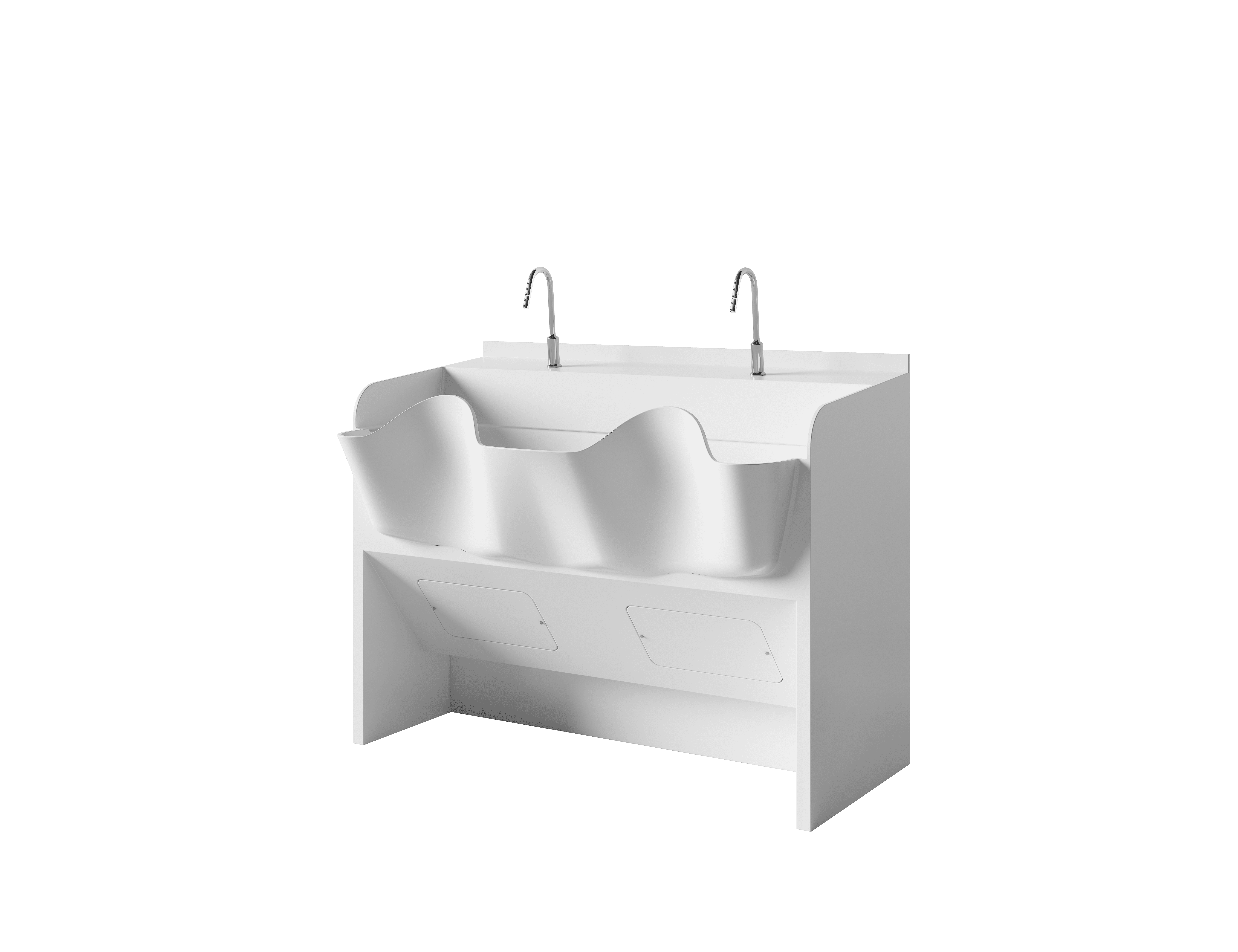
Curved splash guard with arm support
An arc-concave guard guides water back into the basin instead of deflecting it outward, and doubles as an arm rest so clinicians scrub in a natural standing posture rather than leaning forward.
Deep, seamless basin
Basin depth around 300 mm contains spray from high-flow rinsing. In solid surface construction, the basin is thermoformed as one piece — no welded seams, corners, or joints where bacteria can colonize.
Hands-free faucet with anti-splash nozzle
Sensor-activated faucets remove a contact point and reduce water waste. Anti-splash nozzles disperse flow in a petal pattern rather than a direct stream, and rotating outlets adapt to different user heights. Manual (knee- or elbow-operated) faucets remain a valid lower-cost, lower-maintenance option for general clinical areas.
Sealed cabinet construction
Cabinet panels in 18 mm solid surface with six-sided sealing leave no exposed metal or raw board in the humid under-sink zone — eliminating the rust and swelling that shorten cabinet life in OR environments.
Configurations: Single, Double, or Triple Station
Station count should follow surgical volume and peak scrub-in overlap — not just available wall length.
| Facility Profile | Daily Surgical Volume | Recommended Configuration |
|---|---|---|
| Outpatient / day surgery center | Under 10 procedures | Single station |
| General hospital OR suite | 10–30 procedures | Double station (most specified) |
| Large tertiary hospital | 30+ procedures | Triple station |
| Retrofit with limited space | Any | Single station, basin type |
Typical slot-type footprints run approximately 800 mm wide for a single station, 1400 mm for a double, and 2000 mm for a triple, at a working height of 850 mm. Confirm exact dimensions against project technical drawings before finalizing wall openings and services.
How to Choose a Surgical Scrub Sink: Station Count, Type & Faucet Selection
A step-by-step selection logic covering surgical volume, room type, mounting method, and sensor vs manual faucets.
Installation Planning: Mounting Methods and Utility Requirements
Scrub sink installation succeeds or fails at the coordination stage — wall structure, drainage position, and power for sensor faucets.
| Method | Best For | Structural Requirement |
|---|---|---|
| Wall-mounted | New OR construction (mainstream choice) | Solid brick or reinforced concrete wall |
| Floor-standing | Triple stations, retrofit projects | Reserved floor drain position |
| Cabinet type | Clinics, wards, public areas | Standard floor and wall fixing |
Standard utility connections: DN15 (1/2") cold and hot water inlets, DN50 (2") drain with trap recommended, and a 220 V power point where sensor faucets are specified. Rough-in positions should follow the supplier's installation CAD drawing before wall finishing.
Scrub Sink Installation Guide: Wall-Mounted vs Floor-Standing + Utilities
Complete rough-in requirements, mounting selection, and the coordination checklist contractors need before the scrub sink arrives on site.
Standards & Certifications for Surgical Scrub Sinks
Certification requirements vary by market — but a core portfolio answers most tenders.
For international hospital projects, the documents most frequently requested are ISO 9001:2015 (quality management), CE Declaration of Conformity, EN 14688 (the EU washbasin standard, a prerequisite for European and high-end tenders), a third-party antibacterial test report, and fire-performance classification of the material. Country-specific device registrations — such as Indonesia BPFK, Saudi SFDA/SASO, or Malaysia MDA — apply in their respective markets and should be raised early in the project timeline.
Scrub Sink Certifications Explained: CE, EN 14688, ISO & Antibacterial Testing
What each certificate covers, which markets require it, and the document package to request from any supplier before shortlisting.
Maintenance & Lifecycle: Planning Beyond Handover
Lifecycle behavior differs sharply between materials — and it changes the procurement math.
Solid surface is refinishable in place: a light re-polish every 5–8 years restores the original gloss without removing the unit, supporting a design service life beyond 15 years. Stainless steel cannot be refinished in place; visible wear typically appears within 2–3 years in high-use settings and full replacement is the usual remedy at end of life. For facilities planning long-term use, this difference drives the total cost of ownership comparison. For projects with defined lifecycles or limited upfront capital, stainless steel's lower entry price can still be the better fit.
Maintenance practices that void warranties
- Cleaning with strong acids, alkalis, or organic solvents — use neutral cleaners only.
- Pouring boiling water onto a cold solid surface basin (thermal shock).
- Waxing the surface — solid surface is naturally glossy and wax alters its texture.
Solid Surface Maintenance & Scratch Repair: The Facility Team's Guide
Daily-to-annual maintenance schedule, the on-site scratch repair procedure, and what a typical warranty does and does not cover.
The Complete Surgical Scrub Sink Article Series
This pillar guide summarizes each topic. The full series goes deeper on every specification decision.
Surgical Scrub Sink Technical Guides — Full Series
- 01 What Is Solid Surface Material? Composition & Medical-Grade Properties Material
- 02 Solid Surface vs Stainless Steel Scrub Sinks: 11-Point Comparison Comparison
- 03 How to Choose a Surgical Scrub Sink: Stations, Type & Faucets Selection
- 04 Scrub Sink Installation Guide: Mounting & Utility Requirements Installation
- 05 Scrub Sink Certifications Explained: CE, EN 14688, ISO & Testing Compliance
- 06 Solid Surface Maintenance & Scratch Repair Guide Maintenance
- 07 Surgical Scrub Sink FAQ: 12 Questions Buyers Ask Most FAQ
Frequently Asked Questions
A surgical scrub sink is a dedicated hand-washing station installed at the entrance to the operating room's sterile zone, where surgical staff perform hand antisepsis before procedures. Clinical-grade units feature deep basins, splash guards, hands-free faucets, and hygienic surfaces designed for repeated disinfection.
Neither material is universally better — they serve different priorities. Solid surface leads where infection control, ergonomics, customization, and long-term cost of ownership drive the specification. Stainless steel remains a strong choice where initial budget, high-temperature exposure, or immediate local availability are the leading constraints.
As a planning rule: single station for day-surgery units under 10 procedures daily, double station for general hospitals running 10–30 procedures, and triple station for tertiary hospitals above 30 procedures. Peak scrub-in overlap between adjacent theaters can justify moving up one size.
Not universally required, but hands-free operation is standard practice for clean operating rooms because it removes a touch contact point and reduces water waste. Manual knee- or elbow-operated faucets remain acceptable in many codes and are a practical lower-cost option for general clinical areas.
Request ISO 9001:2015 certification, a CE Declaration of Conformity, EN 14688 compliance for European or high-end tenders, and a third-party antibacterial test report if solid surface is specified. Country-specific medical device registrations apply in markets such as Indonesia, Saudi Arabia, and Malaysia.
Design service life exceeds 15 years under normal clinical use. Unlike stainless steel, the surface can be refinished in place — a light re-polish every 5–8 years restores the original gloss without removing or replacing the unit.
ICARELIFE Technical Team
Healthcare infrastructure specialists with extensive experience in modular operating theaters, medical cleanrooms, and MEP system integration. ICARELIFE — Innovating Spaces That Heal.
Related Solutions from ICARELIFE
The scrub sink is one component of a coordinated operating suite. These related systems complete the sterile-zone package.
ICARELIFE — Surgical Scrub Sinks
Specifying a scrub area for your next hospital project?
ICARELIFE supplies seamless solid surface surgical scrub sinks in single, double, and triple configurations — with installation CAD drawings, bilingual documentation, and certification packages for international tenders. Our technical team supports contractors and consultants from specification through installation.