ICARELIFE — Material Comparison
Solid Surface vs Stainless Steel Scrub Sinks: The 11-Point Comparison
An honest, dimension-by-dimension comparison for contractors and hospital planners — including the scenarios where stainless steel is still the right call.
Quick Answer
- Solid surface vs stainless steel is not a head-to-head race — each material serves different project priorities.
- Solid surface leads on hygiene, splash control, ergonomics, customization, and 10-year cost of ownership.
- Stainless steel leads on initial price, high-temperature tolerance, local availability, and recyclability.
- Choose by the customer's leading priority, not by material loyalty.
Solid Surface vs Stainless Steel: The Full Comparison Table
Eleven dimensions, compared side by side. Stainless steel remains the most widely installed scrub sink material worldwide — the comparison below reflects structural differences between the two construction methods, not a judgment on either material.
| Dimension | Solid Surface | Stainless Steel | Edge |
|---|---|---|---|
| 1. Hygiene | Seamless one-piece basin; ≥99.9% antibacterial | Welded seams require rigorous cleaning protocols | Solid Surface |
| 2. Safety | Rounded edges, no sharp corners | Right-angle edges present injury risk | Solid Surface |
| 3. Impact behavior | Thick composite panels resist denting | Sheet metal can deform under impact | Solid Surface |
| 4. Splash control | Curved guard + deep basin return water | Flat guard allows visible splash-out | Solid Surface |
| 5. Ergonomics | Arc arm support; natural standing posture | Forward lean required during scrub | Solid Surface |
| 6. Surface ageing | Refinishable; 10-year anti-yellowing | Scratches visible within 2–3 years, not refinishable in place | Solid Surface |
| 7. Initial price | Higher initial investment | Lower purchase price | Stainless Steel |
| 8. Heat tolerance | Avoid sustained direct high heat | Handles autoclave-adjacent zones | Stainless Steel |
| 9. Availability | Made to order | Often available from local stock | Stainless Steel |
| 10. Customization | Custom colors and dimensions | Standard sizes, single finish | Solid Surface |
| 11. 10-year TCO | Higher entry, lower lifecycle cost (refinishable) | Lower entry, replacement cycles add cost | Solid Surface |
Where Solid Surface Scrub Sinks Win
Four dimensions matter most in practice — all tied to how the sink performs in daily clinical use.
Seam-level infection control
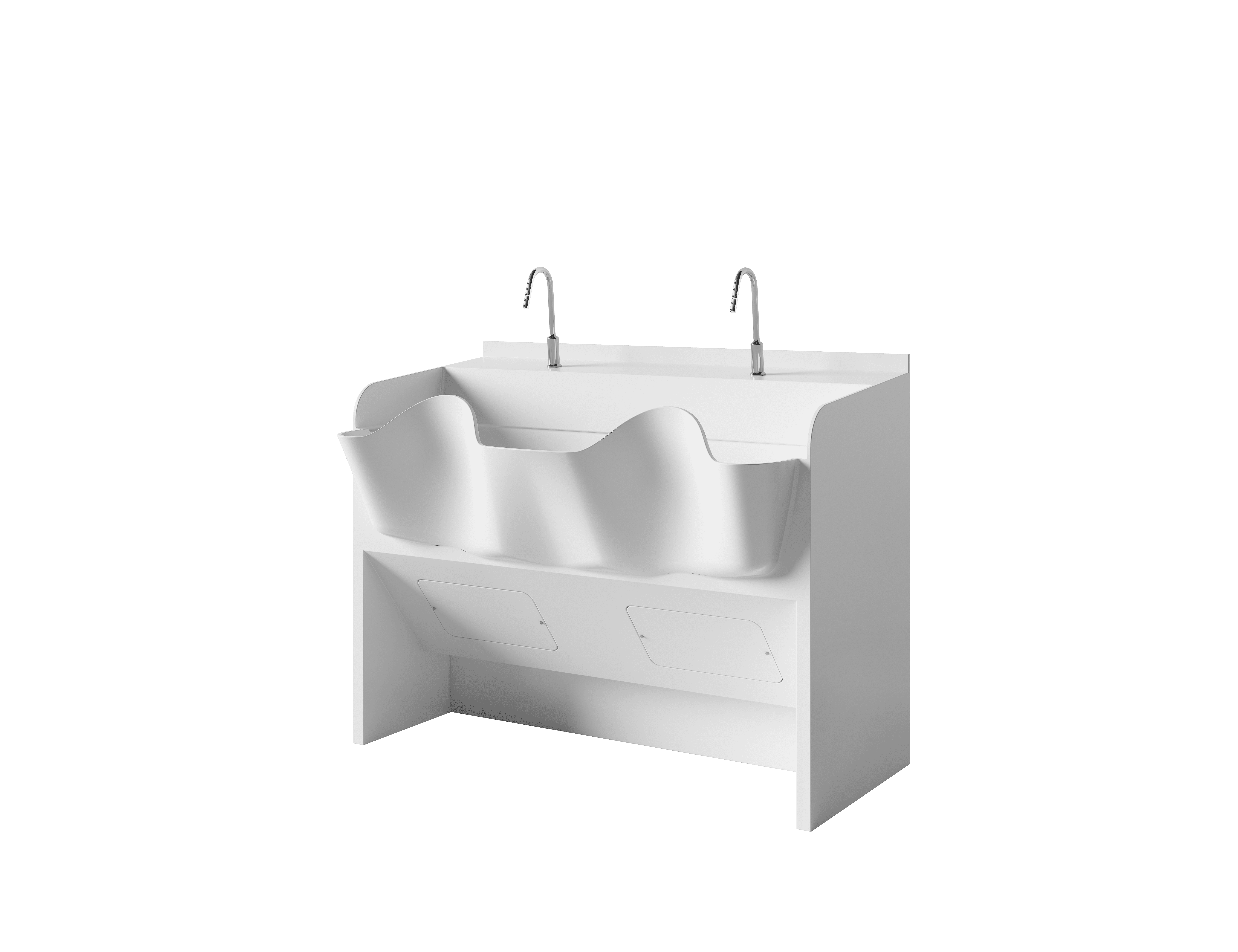
A thermoformed one-piece basin has no welds, joints, or silicone lines. When an IPC team audits the scrub area at seam level, single-piece construction is the direct answer: there is no harborage point for biofilm that routine disinfection cannot reach. Combined with an intrinsic ≥99.9% antibacterial rate, this is the leading reason hospitals switch.
Splash control and ergonomics
A curved, arc-concave splash guard guides water back into a deep basin instead of deflecting it onto floors and scrub attire. The same arc doubles as arm support, so clinicians complete a 2–6 minute scrub standing naturally instead of leaning forward — a posture repeated thousands of times per year per surgeon.
Lifecycle economics
Solid surface is refinishable in place. A light re-polish every 5–8 years restores the surface to new condition, supporting 15+ years of service from one unit. Over a building's life, that compares against one or more full stainless steel replacements — which is why the 10-year TCO usually favors solid surface despite the higher entry price.
Where Stainless Steel Scrub Sinks Win
A credible comparison names the scenarios where stainless steel is the better recommendation.
| Scenario | Why Stainless Steel Fits |
|---|---|
| Hard budget ceiling in a public tender | Lower initial purchase price meets baseline specification |
| Facility standardizes on stainless equipment | Existing spare parts, maintenance training, and inventory |
| High-temperature zones (near autoclaves, hot washers) | Tolerates direct heat without thermal-shock risk |
| Very short lead time required | Frequently available off-the-shelf from local distributors |
| End-of-life recyclability is a priority | Higher scrap metal residual value |
How to Decide: A Priority-Led Framework
Lead with the project's priority, not with a material preference.
Choose solid surface if the leading priority is:
- Infection control at seam level (IPC-led specification)
- Clinician comfort and ergonomics
- Long-term facility planning (10+ years)
- Design integration — custom colors and dimensions
Choose stainless steel if the leading priority is:
- Initial budget or a tender cost ceiling
- High-temperature installation zone
- Immediate availability from local stock
- Alignment with an existing stainless equipment standard
Both paths are legitimate recommendations. The projects where solid surface earns its premium are the ones where the specification is written by — or reviewed by — the infection control team, and where the facility plans to operate the OR suite for a decade or more.
How to Choose a Surgical Scrub Sink: Stations, Type & Faucets
Material decided? The next step is configuration — station count, mounting method, and faucet selection.
ICARELIFE Technical Team
Healthcare infrastructure specialists with extensive experience in modular operating theaters, medical cleanrooms, and MEP system integration. ICARELIFE — Innovating Spaces That Heal.
Related Solutions from ICARELIFE
Continue the surgical scrub sink series.
ICARELIFE — Surgical Scrub Sinks
Comparing materials for a live project?
ICARELIFE supplies seamless solid surface scrub sinks with third-party antibacterial test reports and full certification documentation — and will tell you honestly when stainless steel fits your project better. Send your project profile and our technical team will respond with a materials recommendation.