ICARELIFE — Technical Guide
Choosing an AHU for Modular Operating Theaters
How to select between central and compact AHU configurations, and the technical criteria that actually determine fit for a modular OR project.
Quick Answer
- Central AHUs serve multiple rooms from one plant room but need extensive ductwork; compact modular AHUs sit closer to the operating zone and suit modular or retrofit projects better.
- Filtration should end in H13 or H14 HEPA regardless of AHU type — this isn’t a differentiator between central and compact, it’s a baseline requirement either way.
- Air volume and velocity must be matched to the laminar ceiling system being installed, not selected independently of it.
Air Handling Units condition, filter, and pressurize the air a modular operating theater depends on for sterility. Getting AHU selection wrong doesn’t just mean poor comfort — it means the room may not hold the air changes, pressure, or cleanliness class it was designed to achieve.
Why AHU selection matters
A correctly specified AHU maintains sterile conditions through four coordinated functions:
- HEPA filtration to reduce microbial load in supply air
- Positive pressure control relative to adjacent spaces
- Airflow velocity matched to the laminar ceiling it feeds
- Stable temperature and humidity across the operating cycle
Central vs. compact modular AHUs
Central AHU — fits well when:
Multiple theaters are served from one plant room, ductwork routing is already planned into the building, and centralized maintenance access is preferred over per-room servicing.
Compact Modular AHU — fits well when:
The unit needs to sit close to the operating zone, the project is modular or a retrofit with limited ductwork routing space, or faster installation timelines matter more than centralized servicing.
Key selection factors
- Filtration level: multi-stage filtration ending in H13 or H14 HEPA
- Air volume and velocity: must be matched to the specific laminar ceiling system it feeds, not sized generically
- Ease of maintenance: filter replacement and fan access should be straightforward without disrupting the room above or beside it
- Noise levels: low enough not to compromise patient and staff comfort during procedures
- Compliance: should meet ASHRAE 170, HTM 03-01, or DIN 1946-4 depending on project region, and ISO 14644 for cleanroom classification
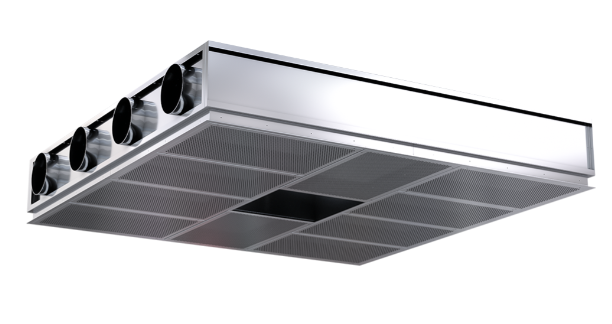
Photo needed — Compact Modular AHU product shot
ICARELIFE’s Compact Modular AHU
ICARELIFE’s Compact Modular AHU is engineered for integration into modular healthcare projects, with built-in filtration and plug-and-play connectivity. It provides pre-configured pressure zones, airflow customizable to match the laminar ceiling system in use, minimal installation time, and low energy consumption.
Frequently Asked Questions
Central AHUs suit multi-theater facilities with planned ductwork and centralized maintenance preferences. Compact modular AHUs suit modular construction and retrofit projects where ductwork space is limited and faster installation matters.
Multi-stage filtration ending in H13 or H14 HEPA is standard regardless of whether the AHU is central or compact — this is a baseline requirement, not a differentiator between AHU types.
Yes. Air volume and velocity from the AHU must be matched to the specific laminar ceiling it feeds — an AHU sized independently of the ceiling system risks under- or over-delivering the airflow the laminar ceiling needs to perform correctly.
Related Products & Guides from ICARELIFE
ICARELIFE — Air & Climate Systems
Get tailored AHU recommendations for your project
Send your room requirements and target compliance standard for a scope-matched AHU proposal — central or compact.